Showing posts with label SOPO. Show all posts

Sunday, 2 September 2012

The SOPO - A Punishment Without A Crime (Part 1)

SOPOs (i.e. Sexual Offences Prevention Orders) are now being used*, in lieu of prison sentences, to punish, satiate ill-informed public and police opinion and to infringe (no, stomp all over) the civil and Human Rights of ex-offenders. It should also be noted, that a SOPO may be applied for, against ex-offenders who have no previous 'sexual' convictions.

*****
Sexual Offences Prevention Orders - Andrew Keogh
This eBook is provided free to all CrimeLine users with our compliments
November 2011, CrimeLine
Sexual Offences Prevention Orders after R. v. Smith - Nicola Devas
Sexual Offences Prevention Orders (SOPO’s) were introduced by the Sexual Offences Act 2003 ss104-113 and have recently been extensively reviewed by the Court of Appeal in the case of R .v. Smith & others, OPB 2012
Is My SOPO Lawful? - 13KBW

R v Beeden – Case Comment (Breach of a SOPO)

SEXUAL OFFENCES PREVENTION ORDERS - VOLUMES 1 AND 2


Individuals convicted of sexual offences - Sexual offence convictions - SOPOs Included

Sexual Offences - Sexual Offences Prevention Order (SOPO) - CPS

S113. Breach of SOPO or interim SOPO - CPS

Guidance On Part 2 Of The Sexual Offences Act 2003 - HO

Sexual Offences Act: Definitive Guidelines - SGC

Sexual Offences Prevention Orders – Tips for practitioners
*****

Here is one example, there will be more to follow:
Re: SOR legislation fighting fund!...« Reply #40 on: Today at 10:33:17 »

"I work with someone who is on the Register and still has a job - though not the same job he had before his conviction for downloading. He is basically a good man, in his late 50s. The prosecution got a SOPO and tried to stop him having Internet access but because of the ruling in R v Smith and others last year they had to allow him access through the library. He can't even have Internet access on his phone. He wasn't imprisoned for the offences but obviously would be if he reoffended. Instead he is on a 3 year probation order and on the register for life.

Apparently, he is a great fan of the opinion site and has been following this forum ever since it started and when this thread started, he thought that at last there was hope for the future. But he told me straight that he is terrified of even making a post here because the police have told him that if he contacts any other sex offender by any means* - including online forums - they will ask for the SOPO to be varied, he will lose all access to the Internet and they will seek to imprison him as his risk will be seen as having increased."

http://theopinionsite.org/forum/sex-offenders-register-%28notification-requirements%29/sor-legislation-fighting-fund!/msg541/#new
*contrary to Articles 18, 19, 20 and 27 of the UDoHR and Articles 9, 10, 11, and 14 of the ECoHR.

To be continued.

Nigel

Monday, 27 August 2012

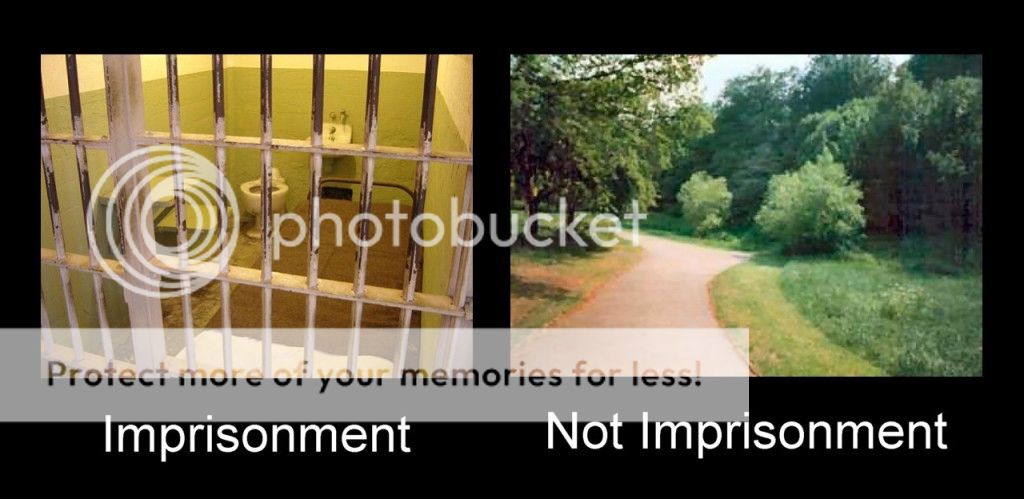
What Is 'Imprisonment'?

76 Meaning of “custodial sentence”.
(1) In this Act “custodial sentence” means—

(a)a sentence of imprisonment (as to which, see section 89(1)(a) below);

(b)a sentence of detention under section 90 or 91 below;

(c)a sentence of custody for life under section 93 or 94 below;

(d)a sentence of detention in a young offender institution (under section 96 below or otherwise); or

(e)a detention and training order (under section 100 below).

(2)In subsection (1) above “sentence of imprisonment” does not include a committal for contempt of court or any kindred offence.

Powers of Criminal Courts (Sentencing) Act 2000
imprison v. 1 put in prison. 2 confine. imprisonment n.

Pocket Oxford Dictionary
Nigel

A Letter To The Home Office (Part 1)

I could not have put most of it better, myself:
"Re: R v Wiles ruling - justice?
Today at 16:51:21

The fact is that different forces cannot lawfully apply the rule from a date they choose, so an authoritive decision will need to take place. If they choose the 1997 date, this will lead to hundreds who have completed their notification being required to re-start, and you can hear the costly legal challenges already.

The RvW ruling was on 4/3/04, and should have set a precedent, however it did not and judges continued to sentence under the interpretation of the 1997 act, upheld in R v Graham S 2001. In fact even as late as this year, judges were still not applying RvW in some cases I read.

The Home Office themselves did not become aware of the ruling until April 2005, and even though the ruling was in relation to being banned from working with children, they decided it was a useful tool to hit all those with a sexual offence, so it could be argued that it is being used beyond it's remit.

As more and more are now coming to the end of their 'given' sentence, the challenges will mount. The media will blow it up as 'paedophiles being released', but that is to be expected. But the truth is more than that, it is the police and government riding over a sentence that has been passed and declared in open court and not challenged at the time by the Crown. It was accepted as correct, and indeed in most cases was correct interpretation at the time.

the arguments must be put forward that retrospective increases cannot happen in any case, no matter how emotive you feel about the offence. For example, if you were caught speeding at 58mph in a 50 zone, you will receive due punishment. If 2 years later they changed the speed limit of that section of road to 30mph, would they retrospectively say you were now doing 28mph over the limit, almost twice the limit, and your penalty will now be increased?

No, because that was not the circumstances at the time. In my case, at the time I was sentenced, the correct notification period was 10 years, and you simply cannot get away from that fact.

The police and Home Office need to swallow their pride, stop pandering to the media and accept that the judge passed a sentence. If he made a mistake, it needed to be challenged at the time, not 7 years later."

http://theopinionsite.org/forum/case-law-new-law-court-of-appeal-decisions/r-v-wiles-ruling-justice/60/
Nigel

Wednesday, 22 August 2012

On R v Wiles

A reply, from me, in a forum thread:

R v Wiles ruling - justice?
"M-N,

An ES under the CJA 2003, is not the same as an ES before it. As for the LASPO, I have some detailed documentation on it, but, will wait for the Act. Of course, as the ROA periods are to be 'reduced', that should be translated to the SOA requirements (for the reasons are identical) - do you think they will be? I will be asking the HO on Friday, for their thoughts, on the matter.

WM"
"Hi WM.

I'm at a disadvantage. How is an ES different pre and post CJA 2003?" 
"An extended sentence may be imposed, under section 227 of the Criminal Justice Act 2003 (as amended) on an offender aged 18 or over where the following criteria are met:

>the offender is guilty of a specified violent or sexual offence;
>the court assesses the offender as a significant risk to the public of committing further specified offences;
>a sentence of imprisonment for life is not available or justified; and
>the offender has a previous conviction for an offence listed in schedule 15A to the Criminal Justice Act 2003 or the current offence justifies an appropriate custodial term of at least four years."

http://sentencingcouncil.judiciary.gov.uk/sentencing/extended-prison-sentences.htm
"What is an extended sentence? 

An extended sentence is a determinate sentence comprising an appropriate custodial term plus an extended period of licence. The appropriate custodial term is the determinate period of imprisonment that would have been imposed if the offender was not dangerous, but it must be for a minimum period of 12 months. It is defined as "the shortest term (not exceeding the permitted maximum) that in the opinion of the court is commensurate with the seriousness of the offence, or the combination of the offence and one or more offences associated with it": section 153(2) CJA 2003. Despite the requirement of the condition in section 227(2B) that the appropriate custodial term must be 4 years (i.e. 2 years actually in custody), it is possible in some circumstances that that an offender may receive an extended sentence with an appropriate custodial term of less than 4 years if he satisfies the previous conviction criteria in section 227(2A). The extension period is "of such length as the court considers necessary for the purpose of protecting members of the public from serious harm": section 227(2) CJA 2003. It may be up to 5 years for a specified violent offence and 8 years for a specified sexual offences: section 227(4) CJA 2003. The sum of the custodial term and the extended licence must not exceed the maximum penalty for the offence: section 227(5) CJA 2003."

http://www.cps.gov.uk/legal/s_to_u/sentencing_and_dangerous_offenders/#a16
The CJA 2003 http://www.legislation.gov.uk/ukpga/2003/44/contents introduced the concept of dangerousness, much more rigorously (and severely), to the ES (which caused me no end of fun, inside, at the time).

Prior to that [CDA 1998; http://www.legislation.gov.uk/ukpga/1998/37/part/IV/chapter/I/crossheading/sexual-or-violent-offenders/enacted, then the PCC(S)A 2000 http://www.legislation.gov.uk/ukpga/2000/6/section/85] the judge could extend the sentence (i.e. 'would not be adequate for the purpose of preventing the commission by him of further offences and securing his rehabilitation' - which the PSR almost always did, based on no valid theoretical, research etc evidence, in those days - even less so, now), so as to 'assist the offender in their rehabilitation' etc (see the David Lee piece) ...
36 Bedford Row
This is why sentences are now 'lesser' [sic], in many cases, so that they get the 'care in the community', which would not happen, inside, because they would not be dangerous enough for 4 years or more. Of course, the populist quid pro quo is, usually, the court application, of an unwarranted and unjustified SOPO.
This is why ES's, prior to 2003, could never be meant to lead to indefinite notification.
Note, Wiles [http://www.bailii.org/cgi-bin/markup.cgi?doc=/ew/cases/EWCA/Crim/2004/836.html&query=Wiles&method=boolean] [4th March 2004], was after the CJA 2003 [20th November 2003], so that is why the outcome was as it was (quashing Graham [R v Graham (S) [2001] 1 Cr App R 111]), which was correct, before 2003).

You will not find much of this stated, officially (for it is contentious, legal, history), although the odd judge will whine about it.

WM"
Addendum (27/8/2012)

"This case is governed by the extended sentence regime of the PCC(S)A 2000, not the successor regime of the CJA 2003 ..."

[2011] EWHC 1610 (Admin)

R (on the application of Minter) v Chief Constable of Hampshire Constabulary and another

Nigel